
Medicine
His meticulous Latin account of the case of “Mary of Bologna”, long dismissed, was recognised in the 1970s as a very rare twin pregnancy, the embryos dead at different dates and calcified.
c. 1175 – c. 1235 · Toledo · Bologna · Palermo
Scholar of four major fields at a hinge of history
Remembered as a wizard and recognised chiefly as a translator, Michael Scot carried four major fields from the Arabic-speaking world into Latin Europe: medicine, mathematics, astronomy/astrology and alchemy. Recent research shows that his contributions have been missed, or underestimated.
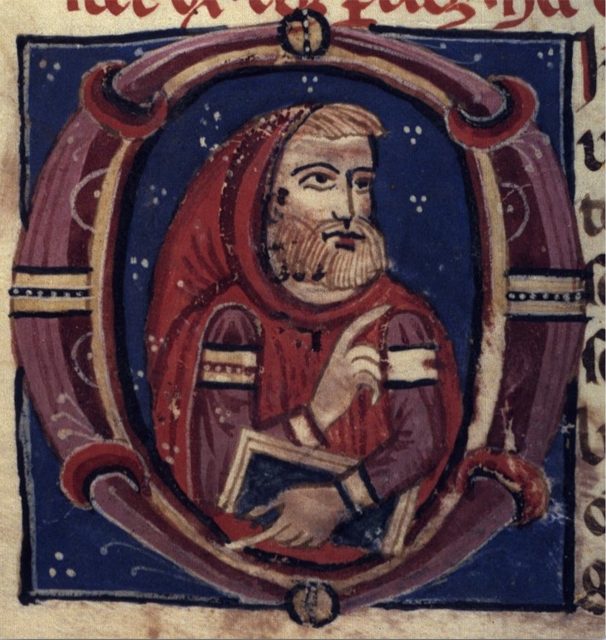
Seven hundred and sixty years ago, a young Scotsman left his native glens to travel south to Toledo in Spain. His name was Michael, his goal to live and work at the Arab Universities of Toledo and Cordova.
Toledo’s and Salerno’s schools, representing as they did the finest synthesis of Arabic, Greek, Latin and Hebrew scholarship, were some of the most memorable of international assays in scientific collaboration.
I
In the late twelfth and early thirteenth centuries, learning that had been preserved and enlarged in the Islamic world began to flow into Latin Europe. It was, in effect, a technology transfer in four fields: mathematics, astronomy/astrology, alchemy and medicine. Most translators carried one of them. Michael Scot was involved in all four, with complementary interests in meteorology and music.
His meticulous Latin account of the case of “Mary of Bologna”, long dismissed, was recognised in the 1970s as a very rare twin pregnancy, the embryos dead at different dates and calcified.
Leonardo Fibonacci dedicated the 1227–28 version of his Liber abaci to him. For Frederick II, Scot and Fibonacci undertook difficult calculations with the astrolabe, such as the heights of towers and mountains.
In Toledo in 1217 he finished translating al-Bitrûjî’s astronomy, the first work to present a non-Ptolemaic system. His ideas on music and the heavens form a thread from Pythagoras to Kepler.
Writings ascribed to him pair metals with planets, gold with the Sun. Recent work suggests this knowledge may have served the purity of Frederick’s Augustalis gold coin.
II
Some periods turn on remarkably few people. A historical hinge, in the sense used by Jacques Benoist-Méchin, is a period when a relatively small group of people has a profound effect on the survival, growth or demise of a civilisation.
The early thirteenth century was one. At its centre stood the Emperor Frederick II (1194–1250), and around him Michael Scot, Leonardo Fibonacci, Sultan al-Kamil of Egypt, Pope Honorius III, his mentor and a major connection, Hermann von Salza, Grand Master of the Teutonic Knights, and, a few centuries earlier, the mathematician Abû-Kâmil, with others before and after.
A relatively small number of people, perhaps fewer than fifty, spread over a few centuries, carried this transmission.
Lose a handful of them and the story of European science might have been very different. That fragility is the reason to remember each one.
III
Michael Scot stands in a relay, not at a starting point. Greek geometry and Indian works on spherical trigonometry had been translated into Arabic about a generation before Al-Khwârizmî did his great work; underneath the creation of algebra lies, in part, geometry. Scot and his colleagues then translated it back, carrying the work of Muslim scholars into Latin (and to some extent Greek), and thereby partially recovering what Euclid, Archimedes and Eudoxus had achieved.
In Toledo, a town then shared by Christians, Jews and Muslims, Scot worked under Archbishop Rodrigo Jiménez de Rada of Toledo, his host in Spain, with whom he had travelled to Rome for the Fourth Lateran Council in 1215. Rodrigo was a major catalyst of the Reconquista, and of the Christian victory at Las Navas de Tolosa in 1212. There, in 1217, he completed his translation of al-Bitrûjî’s On the Motions of the Heavens, and before 1220 Aristotle’s De animalibus. He also translated the commentary of Averroes (Ibn Rushd, 1126–1198) on Aristotle’s De caelo, bringing Averroes into Latin.
The Toledo school, Scot among them, likely provided the Latin copies of Al-Khwârizmî and Abû-Kâmil that Fibonacci used. Scholars have argued that a Latin translation of Abû-Kâmil must have existed by the twelfth century.
A thread that did not cross. Omar Al-Khayyâm, argued by some to be the greatest mathematician of the Islamic Golden Age, never reached Leonardo; Fibonacci was probably unaware of his work (Rashed 1994). The transmission was selective, and fragile.
IV
Frederick II’s tutor and mentor in his youth was Cardinal Cencio Savelli, the future Pope Honorius III, who supported Michael Scot’s career as well. Honorius’s successor, Gregory IX, became the emperor’s enemy: he excommunicated Frederick in 1227 for delaying his crusade, and Frederick sailed in 1228 still under the ban.
What followed was not a battle. In February 1229 Frederick and Sultan al-Kamil agreed a treaty: Jerusalem was returned to the Christians while the Temple Mount, with al-Aqsa and the Dome of the Rock, stayed in Muslim hands. The pope and the Templars opposed the settlement, and the city was lost again in 1244.
Scot spoke Arabic, and some sources report that Frederick used him as an envoy to al-Kamil and brought him to the Holy Land in 1228–29. His part in the diplomacy is likely, though not documented in detail.
V
In 1994 Charles Burnett wrote that Michael Scot’s life and works were “still shrouded in mystery”, and that “scholarly work on Michael Scot is in its infancy”. The papers below are the next chapter. Several needed a scientist’s eye: Haskins misread the medical case of Mary of Bologna, and Thorndike could not judge the four rainbows.
Medicine
Scot’s very detailed Latin description of a woman’s case, once dismissed as a calcified fibroid tumour, was understood in the early 1970s (O’Neill, 1973–74) to be a very rare miscarriage, not followed by immediate expulsion, of twin embryos dead at different dates and calcified. He had recorded in the 13th century a case not fully appreciated until the 20th.
Mathematics
Fibonacci dedicated the revised 1227–28 version of his book to Scot: “You have written to me, my Lord Michael Scotus, supreme philosopher, that I should transcribe for you the book on numbers…”. Scott and Marketos argue that the Fibonacci sequence came from the mercantile culture of Bejaia, perhaps through the ancestry of bees, and suggest a collaboration with the Toledan translators, Scot in particular.
New to Fibonacci numbers? Ron Knott’s Fibonacci Numbers and the Golden Section is the most accessible introduction.
Scott & Marketos, MacTutor, 2014
Meteorology
Scot wrote that “four bows, and maybe more, can be formed at once”. Scholars of his time did not believe more than two were possible, and as late as 1959 the quaternary bow was said not to appear in nature. Tertiary and quaternary rainbows were observed in 2011. The passage may also hint at Scot’s whereabouts: such sightings are known in Tuareg lore of the Sahara. To have heard of them, Scot likely travelled as far as Morocco, well south of Toledo into Muslim lands.
T. C. Scott, Transversal 2 (2017)
1959: C. B. Boyer, The Rainbow: From Myth to Mathematics (1959), as cited by Thorndike, Michael Scot (1965) · 2011: Großmann, Schmidt & Haußmann, Applied Optics 50 (2011) F134 (tertiary); Theusner, Applied Optics 50 (2011) F129 (quaternary)
Astronomy & music
Kepler’s “music of the spheres” (Harmonices Mundi, 1619) can be traced back to Pythagoras and Ibn Arabī through Michael Scot. The thread runs on to orbital resonances, now central to celestial mechanics, from the moons of Jupiter and Saturn to exoplanet systems. Fibonacci numbers, found by Scot’s colleague Leonardo, play a significant role in this story.
Scott & Harper, Transversal 15 (2023)
Alchemy & measure
Around 1229–31 Frederick II introduced the Augustalis, modelled on the Roman aureus: 20½ carats, 5.28 grams, adapted to trade with both the Islamic and Byzantine worlds. Scot was definitely helpful in its measures and calculations, and his alchemy could have helped with extracting and purifying the gold: a behind-the-scenes role, and an “entrepreneurial alchemy” centuries before Newton brought alchemy to the British Mint.
Frederick’s curiosity reached into measurement itself: “to satisfy his curiosity, great scientists, such as Michael Scot and Leonardo Fibonacci, were obliged to undertake difficult calculations using the astrolabe.” This was part of a wider order: “the third book of Frederick’s Constitution laid down three specific rules on weights and measures”, applied to everyone, with sanctions against counterfeiters so that none of the king’s subjects were cheated.
T. C. Scott, Transversal 19 (2025)
A Nobel laureate’s Scot
In his 1979 Nobel lecture Abdus Salam placed Scot at the medical school of Salerno, meeting the Danish physician Henrik Harpestraeng, whose sources were the medical canons of al-Razi and Avicenna, “which only Michael the Scot could translate for him”.
A. Salam, Nobel Lecture, 1979
VI
Highlights adapted from Dr Tony C. Scott’s own chronology. The chronology of Michael Scot’s life is uncertain; dates marked “c.” are approximate. Filled markers fall within his lifetime.
VII
Though well regarded by the papal authorities around 1227, Michael Scot soon acquired the sinister reputation of a magician. Dante placed him among the sorcerers and false prophets in the eighth circle of Hell:
Quell’altro che ne’ fianchi è così poco,
Michele Scotto fu, che veramente
de le magiche frode seppe ’l gioco.
Dante’s commentators read “so spare in the flanks” as a description of his dress: the close-girt waist he had adopted among the Moors of Toledo. J. Wood Brown found a figure “answering nearly” to it in a fresco on the south wall of the Spanish Chapel of Santa Maria Novella in Florence: a slight, dark man in a long, narrow-waisted reddish robe and a tall red pointed cap, tearing the leaves out of a heretical book. Brown cautioned that it would be “too much to assert” that the figure was meant as a portrait of Michael Scot (Brown 1897, pp. 138–140).
The legend outlived the scholar. He was “rescued” only much later, in Sir Walter Scott’s Lay of the Last Minstrel, and still as a wizard. Part of the problem was the age itself: science, superstition, religion and magic were fused together, and astronomy was still called astrology. Part of the problem was the scholarship: so many works were falsely attached to his name that his real ones were hard to see.
Scot was an early chapter in a longer story. Later came the martyrs of science: Giordano Bruno, burned at the stake in 1600, and Galileo, forced to recant in 1633 and kept under house arrest until his death in 1642. It took time and effort to pull out of the dark ages, and to get, eventually, to computers and AI. Al-Khwârizmî’s name still lives in the word algorithm.
VIII
When talk of a “clash of civilisations” is again in the air, Scot’s life is a reminder of what people from different traditions can build together even during turbulent times. In Toledo, Christian, Jewish and Muslim scholars worked side by side; in Salerno, by Salam’s account, Arabic, Greek, Latin and Hebrew scholarship met; in 1229, a treaty rather than a battle opened Jerusalem.
Abdus Salam saw his own career in this light. His colleague Tom Kibble wrote that “Salam saw himself in some ways as a latter-day Michael”, and Salam built his centre in Trieste as a new Toledo, for scientists from the developing world. The transmission of knowledge has always depended on a few people willing to cross a divide.
IX